Glossary
Last updated:2023-02-21
Glossary
Basic Terms
| Term | Meaning |
|---|---|
| Project | The highest business isolation unit in Jiguang Operation Growth. Business data and user data are isolated between different projects. |
| appkey | The application ID that can be integrated into an Operation Growth project. Currently, each project supports adding only one application. APPKEY can be used for Android, iOS, Web, mini program, official account, HTTP API, and other platforms. |
| Master Secret | Used together with AppKey for authentication when developers call Jiguang service APIs. Keep the Master Secret secure and prevent leakage. |
| Data Source | The source from which Operation Growth obtains data. It supports business scenarios such as Operation Growth feature requirements, data collection, and reporting. Data sources include Android, iOS, Web, WeChat Mini Program, WeChat Official Account, and HTTP API. |
| Reach Channel | Six channel types, each with its own service protocol: |
| Contact Information | The identifier used to send reach messages and for users to receive reach messages. Each user can have multiple contact methods for each reach channel. |
| User Identifier | All fields that can be used to distinguish user identity. Custom creation by users is supported, such as loginID, ID card number, faceID, device ID, WeChat openID, phone, OAID, and IDFA. |
| Device ID | The terminal user's device identifier ID based on APPKEY. |
| CUID | Unique user ID of an Operation Growth product project. |
Product Analysis
| Term | Meaning |
|---|---|
| Dimension | A dimension describes a characteristic or attribute of an object. For example, a person's gender, city of residence, and favorite color are all attributes of that person. In website analytics, dimensions are often used to describe and analyze metrics. For example, a single visits metric does not tell you much by itself, but once the source dimension is added, it immediately becomes meaningful. |
| Metric | A specific numerical value. For example, number of visitors, page views, and stay duration are common metrics. Metrics are generally more meaningful when analyzed together with dimensions. |
| Visitor | Commonly means a person who visits a website or app. When preceded by Unique, it is what we usually call UV, a unique identity visitor. For data statistics tools, visitors are generally marked with anonymous IDs. Web products use Cookie, a small text placed in the user's browser by the website server, and app products use device ID. |
| Page View | PageView, or PV, refers to the number of times a page is viewed by users. Strictly defined, it is a request in which a user sends to a website and completes downloading a page. The concept of page browsing mainly applies to web products. For app analysis, screen view is now mainly used. |
| Funnel | After users enter a product, the data generated by each event completed in sequence is displayed with a funnel chart, with conversion rate as the core metric. |
| Funnel Window | The time window between preceding and following events in a funnel. If the time window is exceeded, the event is not included in calculation. |
| Conversion Rate | A core metric that every product needs to track. It is mainly used to measure the ability of users to move from traffic to actual target conversion. It is generally calculated by dividing the number of target conversions or users by the number of users or times entering the target conversion funnel. Because target behaviors differ, conversion rate is a very flexible metric. For example, you can define registration conversion rate, login conversion rate, purchase conversion rate, search success conversion rate, and so on. |
| Path | After users enter a product, the data generated by each event branch completed in chronological order is segmented based on Session and displayed with a Sankey diagram. |
| Session | A session sorts events by occurrence time and defines start events and end events within it. The first event behavior is used as the starting point for matching backward.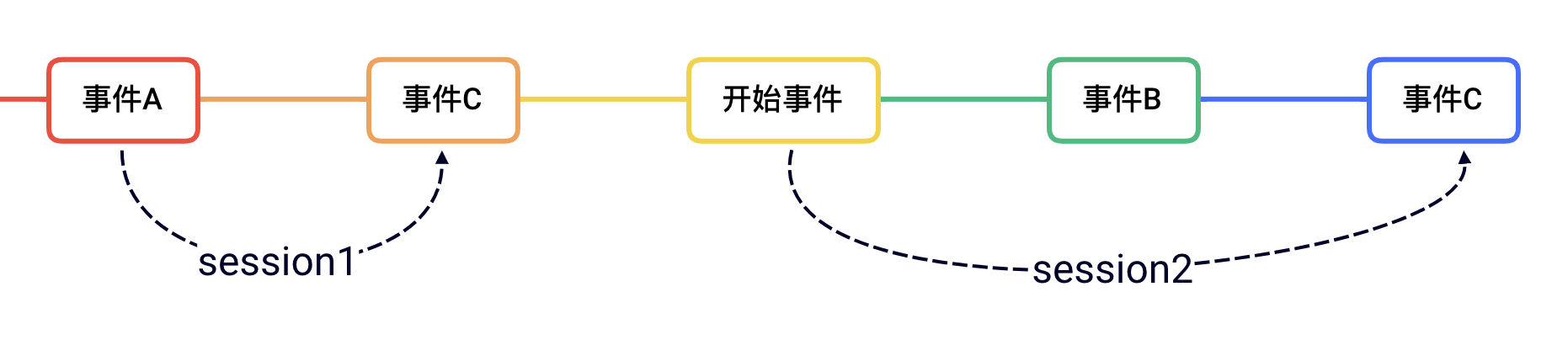 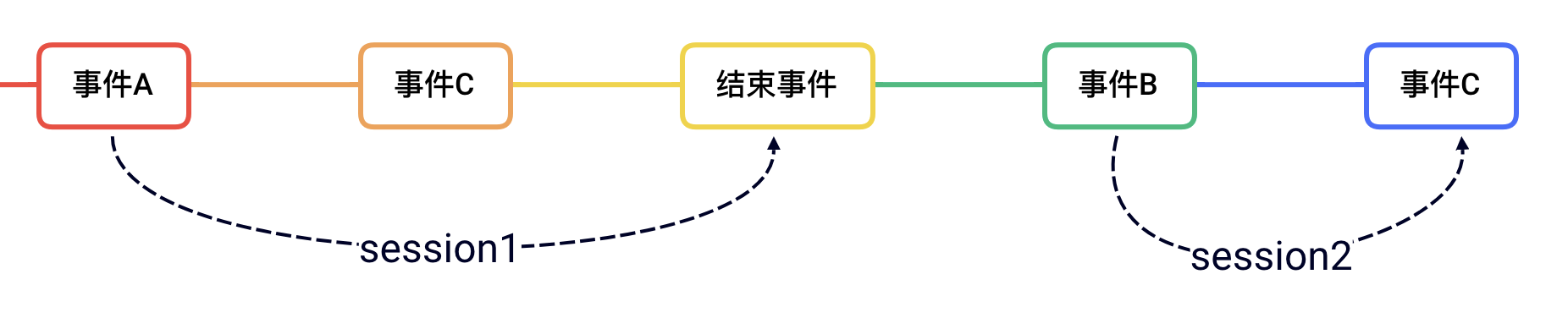 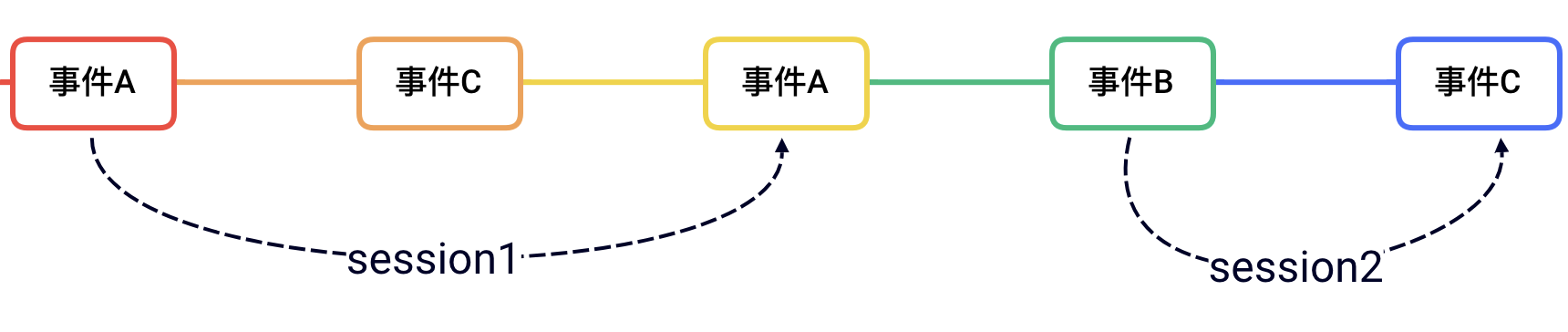 |
| Session Duration | Defines the maximum duration of a Session. If the interval between the start event and end event exceeds this duration, it is split into two Sessions. |
| Retention | Refers to users who, after entering a product, continue or periodically complete certain events in the product, so that they do not meet the churn characteristics defined by the product. |
Was this document helpful?