Basic Definitions
The User Asset Platform (Customer Data Platform) is a user-domain-wide data asset management platform for business operations and growth. It helps enterprises break down data silos, establish unified data profiles for people, objects, and events, drive full-funnel marketing and deep operations with data, and achieve digital transformation and digital marketing growth.
Data Fusion
The platform supports many data source platform types, including Android, iOS, H5, mini programs, APIs, official accounts, and CRM. It aggregates and normalizes user data scattered across different places through user identifier IDs and ID Mapping, forming user data assets.
User Identifier
Users may have different ID systems to identify and distinguish their identities across different business platforms and business stages. These IDs from different systems are collectively called user identifiers in the Jiguang Operation Growth platform.
Preset User Identifiers
To help enterprises quickly start business operations, the Jiguang Operation Growth platform presets commonly used user identity identifiers. The specific preset information is as follows:
| User Identifier | Display Name | Identifier Meaning | Uniqueness | Edit/Delete |
|---|---|---|---|---|
| jg_registration_id | Jiguang device unique identifier | Abbreviated as Jiguang RID, a device unique identifier ID preset by the Jiguang Operation Growth platform | Off | Editing allowed, deletion prohibited |
| jg_UnionID | User membership card number | WeChat platform user identity ID. For the same WeChat mini program, official account, or app subject, one user has one identity identifier ID | On | Editing allowed, deletion prohibited |
CUID (Base ID)
Business scenarios in the Operation Growth platform, such as user behavior, user attributes, user tag generation, audience selection, audience insights, and operation plans, are all implemented based on the base ID. Therefore, the base ID must be generated and uniquely identified in a unified way. The Jiguang Operation Growth platform configures ID Mapping business logic visually and uniformly generates the base ID, abbreviated as CUID, to connect user identifier data from different platforms and channels.
ID Mapping Configuration
The Jiguang Operation Growth platform presets common general-purpose user identifier priority logic. If there are no special business requirements, it is recommended to directly use Jiguang preset data, which can meet most business scenarios. If an enterprise has special business operation scenarios, custom user identifier priority configuration is supported, and adjustments take effect immediately.
CUID Business Logic
- Based on the configured user identifier value, the system checks whether a CUID (base ID) has already been generated according to the configured ID Mapping. If one has been generated, the CUID is reused directly as the user's base ID.
- If no generated CUID (base ID) is found, a new CUID is generated as the user's base ID according to the ID Mapping generation policy configured by the system.
- The business side uses CUID as the base ID to complete business operations such as behavior event reporting, setting user attributes, and generating user tags.
CUID Generation Policy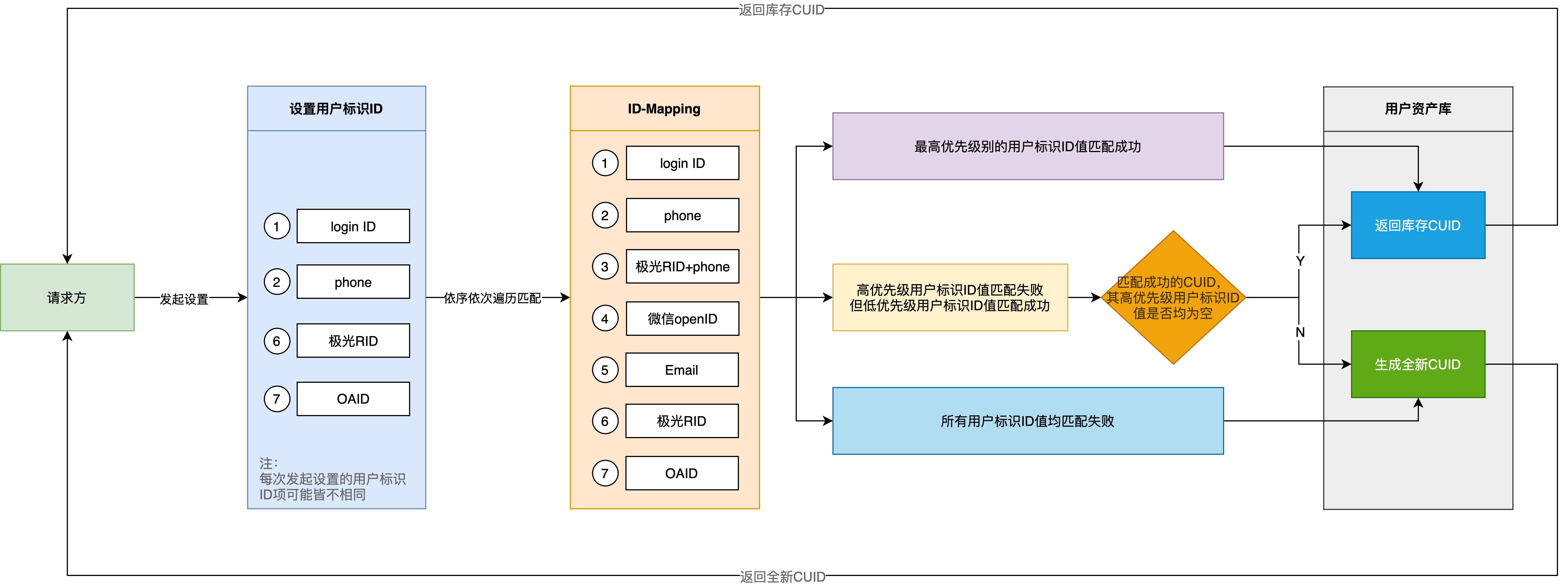
- The priority of user identifiers configured in the ID Mapping business logic is the only basis for user identity recognition.
- When the requester initiates a request to set user identifiers, corresponding user identifier values are generated. Multiple user identifier values are supported.
- According to the user identifier priority in ID Mapping, the user identifier values generated in step 2 are traversed and matched in order in the user asset database.
- If all user identifier values from the requester fail to match, a new CUID is generated in the user asset database and returned to the requester.
- If the requester's highest-priority user identifier value matches successfully, the CUID hit in the user asset database is returned to the requester.
- If the requester's high-priority user identifier value fails to match, but a lower-priority user identifier value matches successfully, no lower-priority user identifiers are matched after a successful match.
- If all high-priority user identifier values of the hit CUID are empty, the CUID hit in the user asset database is returned to the requester.
- If the high-priority user identifier values of the hit CUID are not all empty, a new CUID is generated in the user asset database and returned to the requester.
After step 3 triggers generation of a new CUID or return of an existing CUID:
- All user identifier values set by the requester are traversed in the user asset database. If a match is found, the corresponding user identifier field value of the original CUID is deleted.
- All user identifier values set by the requester are written to the related user identifier fields of the obtained CUID. The original value handling logic depends on the uniqueness switch of the user identifier and the number of stored records. In other words, any user identifier value can belong to only one CUID (base ID) at the same time. For example, the same phone number cannot simultaneously belong to CUID-A (user) and CUID-B (user), and the same device ID follows the same rule.